The Rules of Cybersecurity Have Changed
Imagine arriving at work on a Tuesday morning to discover that a critical vulnerability has just been disclosed in software running throughout your organization.
By Wednesday, security researchers have already analyzed the vulnerability and published technical details.
By Thursday, cybercriminals have developed proof-of-concept exploits and are actively scanning the internet for organizations that haven’t installed the update.
Meanwhile, your IT team has the patch scheduled for next month’s maintenance window.
Unfortunately, this isn’t a hypothetical scenario anymore.
It has become the reality of modern cybersecurity.
Recognizing how quickly threat actors are weaponizing newly disclosed vulnerabilities, the U.S. Cybersecurity and Infrastructure Security Agency (CISA) recently issued Binding Operational Directive (BOD) 26-04: Prioritizing Security Updates Based on Risk. While the directive
specifically applies to Federal Civilian Executive Branch agencies, its message is one every organization should pay attention to.
The takeaway is simple:
The days of waiting weeks or even a month to deploy security patches are over.
Is Your Organization Really Prepared?
Many businesses believe they have a strong patch management process because updates are eventually installed.
But ask yourself a few important questions.
- How long does it take to deploy a critical security update?
- Is that timeline measured in days or weeks?
- Can you identify every vulnerable system across your organization?
- Are third-party applications included in your patch management process?
- Can you confidently prove your systems are fully updated?
If answering those questions isn’t straightforward, your organization may already have a visibility problem.
Cybersecurity isn’t only about having patches available.
It’s about having the operational capability to deploy them quickly and consistently.
Your Biggest Risk May Not Be Windows
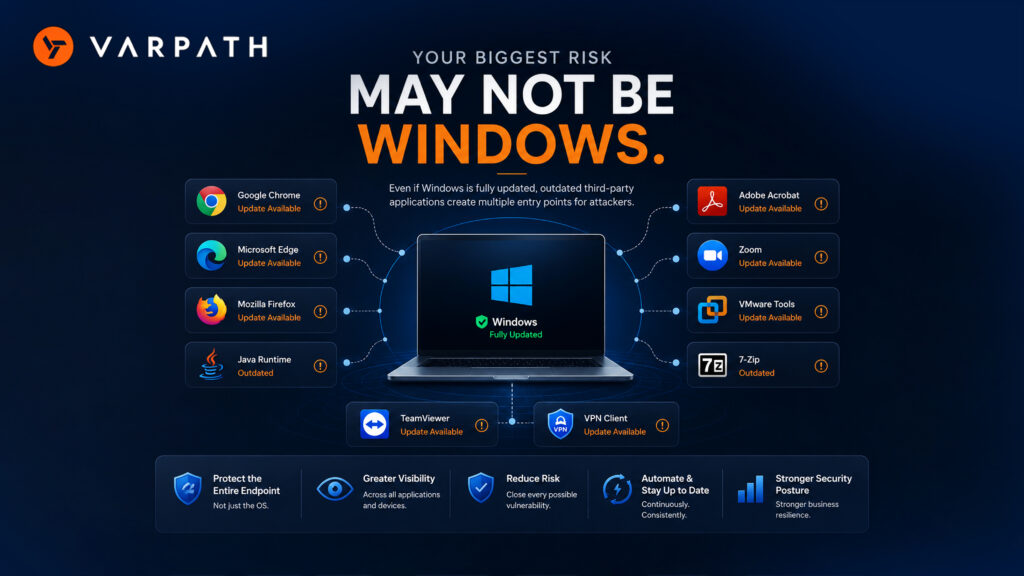
When people hear the phrase patch management, they immediately think about Windows Updates.
Attackers don’t.
Modern ransomware groups and threat actors regularly target vulnerabilities in third-party applications because they’re often overlooked during routine maintenance.
These include:
- Google Chrome
- Microsoft Edge
- Mozilla Firefox
- Adobe Acrobat Reader
- Zoom
- Java Runtime
- VMware products
- 7-Zip
- TeamViewer
- VPN clients
- Remote support software
- Productivity applications
- Development tools
Every application installed on a workstation or server increases your attack surface.
An organization may proudly report that Windows is fully patched while several outdated third-party applications remain vulnerable to publicly known exploits.
To an attacker, that’s still an open door.
Effective patch management means protecting the entire endpoint, not just the operating system.
Automation Is No Longer Optional
One of the biggest lessons reinforced by CISA’s latest guidance is that organizations must reduce the time between vulnerability disclosure and remediation.
The only practical way to achieve this consistently is through automation.
Automated patch management enables organizations to:
- Continuously monitor newly released security updates.
- Prioritize vulnerabilities based on risk.
- Deploy approved patches much faster.
- Reduce manual administrative effort.
- Improve reporting and compliance.
- Maintain visibility across every managed endpoint.
Instead of reacting once a month, organizations can continuously strengthen their security posture every day.
Automation doesn’t replace IT teams.
It empowers them to spend less time performing repetitive administrative work and more time focusing on strategic security initiatives.
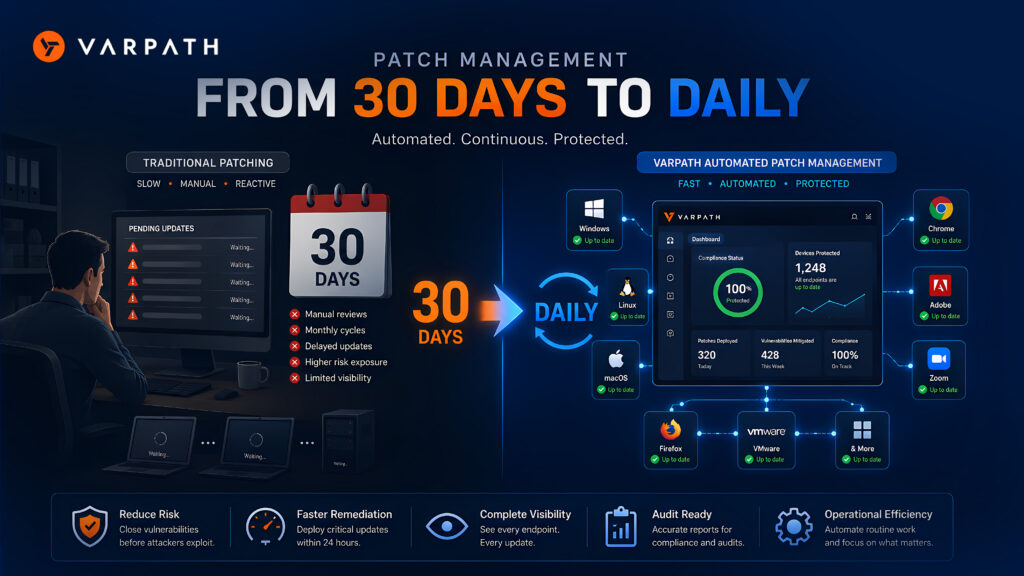
How Varpath Reduces Patch Lifecycles from 30 Days to Daily
At Varpath, we’ve long recognized that attackers don’t wait for scheduled maintenance windows. That’s why our managed patch management services are built around continuous security operations rather than traditional monthly patch cycles.
Our platform supports automated patch deployment across:
- Microsoft Windows workstations and servers
- Linux servers
- macOS devices
- Third-party business applications
Beyond simply deploying updates, we continuously monitor for newly released security patches, identify systems requiring remediation, verify successful deployments, and maintain centralized visibility across managed environments. This enables organizations to significantly reduce the amount of time critical vulnerabilities remain exposed.
Our customers don’t need to wait for a monthly maintenance window to strengthen their security posture. Through automated patch deployment, centralized management, and continuous monitoring, updates can be evaluated, deployed, and verified on a daily basis, significantly reducing the exposure window that attackers depend on.
Whether your environment consists of Windows workstations, Linux servers, macOS devices, or hundreds of third-party business applications, Varpath delivers a consistent, scalable patch management process designed to keep your infrastructure protected while minimizing operational overhead
Why Faster Patching Matters to Your Business
- Tedious IT work of patching is now automated.
- A secure repository ensures downloads are from a safe source.
- Increased operational efficiency through automation.
- Consistent patch deployment across Windows, Linux, and macOS.
- Centralized patch management and reporting.
- Improved compliance and audit readiness.
- Reduced ransomware and malware risk.